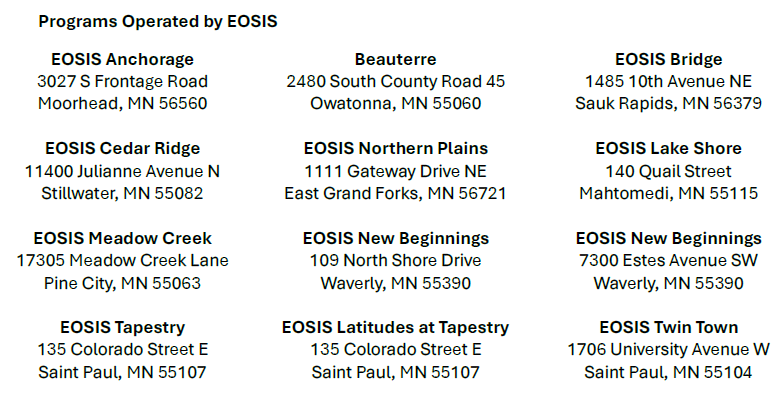
 Beauterre

Notice of Privacy Practice: HIPAA, 42 CFR Part 2, and Minnesota Health Records Act
This notice describes how medical and substance use disorder (SUD) information about you may be used and disclosed and how you can access this information. Please review it carefully.
If you have any questions about this notice, please contact the Privacy Officer at 952-679-5706.
WHO WILL FOLLOW THIS NOTICE
This notice applies to all employees, contractors, trainees, volunteers, and affiliated facilities of EOSIS.
OUR PLEDGE REGARDING PATIENT CARE INFORMATION
We understand that your health information is personal. We are committed to protecting your health information in accordance with:
- The Health Information Portability and Accountability Act (HIPAA)
- 42 CFR Part 2 (Confidentiality of Substance Use Disorder Patient Records
- The Minnesota Health Records Act (MN Statute 144.291-144.298)
We create a record of the care and services you receive from us. We need this record to provide you with quality care and to comply with certain legal requirements. This notice applies to health records generated by each facility regarding your care.
This notice will tell you about the ways in which we may use and disclose patient care information about you. We also describe your rights to the patient care information we keep about you and describe certain obligations we have regarding the use and disclosure of your patient care information.
In cases where federal and state law differ, we will comply with the law that provides you the greatest protection.
We never sell or trade SMS numbers or content. We are required by law to:
- Ensure that patient care information that identifies you is kept private
- Give you this notice of our legal duties and privacy practices with respect to patient care information about you
- Follow the terms of the notice that is currently in effect
- Notify you in the event of a breach of your health information
How we may disclose patient care information about you
The following categories describe different ways that we use and disclose patient care information. For each category of uses or disclosures we will explain what we mean and try to give examples.
Not every use or disclosure in a category will be listed. However, all of the ways we are permitted to use and disclose information will fall within one of the categories.
- For Treatment. We may use patient care information about you to provide you with patient care treatment or services. We may disclose patient care information about you to the doctors, nurses, counselors, technicians, health students, or other personnel who are involved in taking care of you. They may work at our facilities or other healthcare providers to whom we may refer for a consultation, to take x-rays, to perform lab tests, to have prescriptions filled or other treatment purposes. We may also disclose health information about you to an entity assisting in disaster relief efforts so that your family can be notified about your condition, status, and location.
- For Payment. We may use and disclose patient care information about you so that the treatment and services you receive from us may be billed to and payment may be collected from you, an insurance company, or a third party. For example, we may need to give your health plan information about your treatment so your health plan will pay us or reimburse you for the services. We may also tell your health plan about a treatment you are going to receive to obtain prior approval or to determine whether your plan will cover the treatment
- For Health Care Operations. We may use and disclose patient care information about you for operations of our facilities. These uses and disclosures are necessary to run our facilities and make sure that all of our patients receive quality care. For example, we may use patient care information to review our treatment and services and to evaluate the performance of our staff in caring for you. We may also combine patient care information about many patients to decide what additional services that we should offer, what services are not needed, whether certain new treatments are effective or to compare how we are doing with others and to see where we can make improvements. We may remove information that identifies you from this set of patient care information so that others may use it to study healthcare delivery without learning who our specific patients are.
- Health-Related Services and Treatment Alternatives. We may use and disclose patient care information to tell you about services or recommend possible treatment options or alternatives that may be of interest to you. Please let us know if you do not wish us to send you this information or if you wish to have us use a different address to send this information to you.
- Healthcare Oversight Activities. We may disclose medical information to agencies with authority to conduct government oversight activities.
- As Required by Law. We will disclose medical information about you when required to do so by federal, state, or local law.
- To Avert a Serious Threat to Health or Safety. We may use and disclose medical information about you when necessary to prevent a serious threat to your health and safety or the health and safety of the public or another person. Any disclosure, however, would only be to someone able to help prevent the threat.
- Public Health Risks. We may disclose patient care information about you for public health activities. These activities generally include the following:
- To prevent or control disease, injury or disability
- To report reactions to medications or problems with products
- To notify persons or organizations required to receive information on FDA-regulated products
- To notify a person who may have been exposed to a disease or may be at risk for contracting or spreading a disease or condition
- To notify the appropriate government authority if we believe a patient has been the victim of abuse, neglect, or domestic violence. We will only make this disclosure if you agree or when required or authorized by law.
SPECIAL SITUATIONS
- Lawsuits and Disputes. If you are involved in a lawsuit or a dispute, we may disclose patient care information about you in response to a court or administrative order. We may also disclose patient care information about you in response to a subpoena, discovery request, or other lawful process by someone else involved in the dispute, but only if efforts have been made to tell you about the request or to obtain an order protecting the information requested.
- Law Enforcement. We may release medical information to an authorized law enforcement official, as required or authorized by law.
- Coroners and Health Examiners We may release patient care information to a coroner or health examiner. This may be necessary, for example, to identify a deceased person or determine the cause of death.
- National Security and Intelligence Activities. We may release patient care information about you to authorized federal officials for intelligence, counterintelligence, and other national security activities authorized by law.
- Protective Services for the President and Others. We may disclose patient care information about you to authorized federal officials so they may provide protection to the President, other authorized persons or foreign heads of state or conduct special investigations.
YOUR RIGHTS REGARDING PATIENT CARE INFORMATION ABOUT YOU
You have the following rights regarding patient care information we maintain about you:
- Right to Inspect and Copy. You have the right to inspect and copy patient care information in your medical record. Usually this includes health and billing records. To inspect and copy patient care information that may be used to make decisions about you, you must submit your request in writing. If you request a copy of the information, we may charge a fee for the costs of copying, mailing, or other supplies associated with your request. We may deny your request to inspect and copy in certain very limited circumstances, including but not limited to psychotherapy notes or other documentation that is deemed to pose a threat to the patient’s health safety or welfare. If you are denied access to your information, you may request that the denial be reviewed. Another qualified individual chosen by us will review your request and the denial. The individual conducting the review will not be the person who denied your request. We will comply with the outcome of the review.
- Right to Amend. If you feel that patient care information we have about you is incorrect or incomplete, you may ask us to amend the information. You have the right to request an amendment for as long as the information is kept by us.
- To request an amendment, your request must be made in writing and submitted to the Record Request Department and must be contained on one page of paper legibly handwritten or typed in at least 10-point font size. In addition, you must provide a reason that supports your request for an amendment.
- We may deny your request for an amendment if it is not in writing or does not include a reason to support the request. In addition, we may deny your request if you ask us to amend information that:
- Was not created by us, unless the person or entity that created the information is no longer available to make the amendment;
- Is not part of the patient care information kept by or for our facility;
- Is not part of the information that you would be permitted to inspect and copy
- Is accurate and complete.
- Any amendment we make to your information will be disclosed to those with whom we disclose information as previously specified.
- Your letter will be uploaded to the document you are requesting to amend.
- Right to an Accounting of Disclosures. You have the right to request a list accounting for any disclosures of your patient care information we have made except for uses and disclosures for treatment, payment, and health care operations, as previously described. To request this list of disclosures, you must submit your request in writing to the Record Request Department. Your request must state a time period, which may not be longer than 6 years and may not include dates before April 14, 2003. The first list you request within a 12-month period will be free. For additional lists, we may charge you for the costs of providing the list. We will notify you of the cost involved, and you may choose to withdraw or modify your request at that time before any costs are incurred. We will provide you a list of disclosures in your requested format within 30 days of your request, or notify you if you are unable to supply the list within that time period and by what date we can supply the list, but this date will not exceed a total of 60 days from the date you made the request.
- Right to Request Restrictions. You have the right to request a restriction or limitation on the patient care information we use or disclose about you for treatment, payment, or health care operations. You also have the right to request a limit on the patient care information we disclose about you to someone who is involved in your care or the payment for your care, like a family member or friend. For example, you could ask that we not release information to your spouse. We are not required to agree to your request restrictions if it is not feasible for us to ensure our compliance or believe it will negatively impact the care we may provide you. If we do agree, we will comply with your request unless the information is needed to provide you emergency treatment. To request restrictions, you must make your request in writing to the Treatment Team or Record Request Department. In your request, you must tell us what information you want to limit; and to whom you want us to limit and to whom you want the limits to apply.
- Right to Request Confidential Communications. You have the right to request that we communicate with you about health matters in a certain way or at a certain location. For example, you can ask that we only contact you at work or by mail to a post office box. To request confidential communication, you must make your request in writing to the Nurse Manager. We will not ask you for the reason for your request. We will accommodate all reasonable requests. Your request must specify how or where you wish to be contacted.
- Right to a Paper Copy of This Notice. You have the right to a paper copy of this notice. To obtain a paper copy of this notice, contact your Treatment Team or the Record Request Department.
Confidentiality of Substance Use Disorder Patient Records (42 CFR Part 2)
Records related to substance use disorder (SUD) treatment are protected by federal law under 42 CFR Part 2. We may not disclose any information identifying you as having a substance use disorder, or as a patient in a substance use treatment program, without your written consent unless otherwise permitted by law. Federal rules restrict any use of the information to investigate or prosecute any crime potentially involving a patient. A general authorization for the release of medical or other information is not sufficient for this purpose.
Minnesota Health Records Act (MN Statute 144.291-144.298)
Under Minnesota law, your health records are protected under the Minnesota Health Records Act. In many cases, disclosures of your health information to outside entities, including other providers, require your written authorization, unless the disclosure is expressly allowed under law. Health records we disclose under state law may not be redisclosed without your written permission unless otherwise permitted by law.
Changes to this notice
We reserve the right to change this notice. We retain the right to make the revised or changed notice effective for patient care information we already have about you as well as any information we receive in the future. We will post a copy of the current notice in our facility. The notice will contain on the first page, the effective date. In addition, each time you register for treatment, we will offer you a copy of the current notice in effect.
Complaints
If you believe your privacy rights have been violated, you may file a complaint with EOSIS or with the Secretary of the Department of Health and Human Services. To file a complaint with us, contact your Treatment Team, or through the EOSIS Compliance Hotline at EOSIS.ethicspoint.com or by calling 1-844-676-1540. All complaints must be submitted in writing. We will not retaliate against you for filing a complaint.
Other uses of patient care information
Other uses and disclosures of patient care information not covered by this notice or the laws that apply to us will be made only with your written permission. If you provide us permission to use or disclose patient care information about you, you may revoke that permission, in writing, at any time. If you revoke your permission, we will no longer use or disclose information about you for the reasons covered by your written authorization. You understand that we are unable to take back any disclosures we have already made with your permission and that we are required to retain our records of the care that we provided to you.
Acknowledgement of Receipt of this Notice. We will request that you sign a separate form or notice acknowledging you have received a copy of this notice. If you choose, or are not able to sign, a staff member will sign their name/date. This acknowledgement will be filed with your records.
Contact Information
EOSIS Record Request Department
Email: RecordRequest@EOSISRecovery.com Phone: 952-843-4100
Fax: 612-454-2205
Mail: Record Request Department 550 Main Street Suite 190
New Brighton, MN 55112 EOSIS Compliance Hotline
Phone: 1-844-676-1540 Online: EOSIS.ethicspoint.com